I teach through projects that give students something to figure out and something to make. A blinking light becomes part of a creature. A water test becomes evidence for an environmental proposal. A camera becomes a way to tell a story. The five courses below show how I connect those practical skills with the questions behind them.
Students need a clear starting point, time to try things, and help when an idea stops working. I plan the lessons around that process.
These courses come from different periods of my teaching. Three grew out of a high-school media arts program I founded and ran for five years. DEEP is an established program that I revived and now co-teach with a science colleague. I describe the courses here in my own words; the supporting curriculum documents are on my art portfolio, behind a password.
Students make creatures and artworks inspired by the ways living things move, glow and respond to their surroundings. A firefly gives us a reason to look closely at the timing of a blink. A moving fin raises a construction question: where should it bend, and how can we keep it light enough to move? Students use those observations to develop their own designs.
I introduce the tools as the artwork needs them. Students begin with a small movement they can make by hand, then use MakeCode Blocks to try screen expressions and repeating patterns. Buttons let them test a response before they replace that control with a sensor. By the time they measure light and choose a threshold, they have a creature whose behavior gives that number a meaning. The themes below connect those skills to examples from nature.
The finished creatures become a shared display. Each student checks their own artwork in its display position: can visitors see its response, does nearby scenery shade its sensor, and can the moving part travel freely? The final adjustments are part of making the installation work.
Patterns of light
Students look at fireflies, glowing plankton and squid, then make their own light patterns. They change the pauses between lights and watch how a slow pulse feels different from a quick flash.
Movement in nature
Kelp and manta rays give us movements to study. Students try a fin or tentacle by hand before adding a servo, then adjust its shape and range so it can move without catching on the body.
Responding to the surroundings
A creature needs a way to notice its surroundings. Students measure light where the creature will sit, then use an if/else block to choose a response. If it wakes at the wrong moment, we check the readings and the placement together.
Sound in an artwork
Whale calls, dolphin clicks and snapping shrimp introduce different uses of sound. Students can add a short sound to an artwork and explore how changing pitch, rhythm or the input changes the effect.
Bringing the artworks together
A reef suggests how separate creatures might share a setting. Students arrange their artworks together and check the combined light, movement and sound. Radio messages offer an optional way for one board to trigger another.
Marine Science Capstone
DEEP.
DEEP stands for Designing Engineering Excellence Program. I revived the thirty-year-old program, wrote its current curriculum and co-teach it with the school's science teacher. Students choose an ocean or environmental question they can investigate through research, measurements and a prototype. The challenge is to make a useful response and explain what their tests actually show.
The investigations give students a reason to collect their own data. A student testing a filter measures how cloudy the water is before and after it passes through. Another might build a model seawall or use a micro:bit to record sensor readings over time. Visits to AltaSea at the Port of Los Angeles and the Sustainable Water Infrastructure Project connect those classroom questions with people doing related work.
Students bring their research, prototype, website, exhibit, presentation and advocacy work together for a public exhibition. Knowing that someone will ask how they reached a conclusion gives the testing and recordkeeping a purpose. I help them prepare to explain both their findings and the questions they could not answer.
Checkpoints
We review the work at regular checkpoints, while there is still time to change a question, repair a prototype or repeat a test.
Week 3
One to one research meeting; the student finalises their proposal.
Week 5
Data collection check in; experimental plan or initial prototype design submitted.
Week 7
Website framework review. Homepage, research section, and an early draft of findings all have to exist.
Week 8
Midway check on data analysis, prototype testing, and advocacy planning.
Week 10
Final refinements: website, report draft, and a confirmed advocacy initiative.
Week 11
Exhibit construction and presentation preparation.
Week 12
Public exhibition, advocacy event, and final submission.
The Media Arts Program
High-school media arts and humanities
I founded and ran a high-school media arts program for five years, along with its makerspace and media, recording and art studios. The three courses below developed there. Students learned the tools through their own productions, then discussed each other's choices: what a piece communicated, how it was made and where it needed more work.
Media Arts
Introduction to Media Arts
We begin with a camera and a few choices students can see immediately. Changing the shutter speed can freeze a moving subject or leave a blur; changing the aperture affects how much of the scene is in focus. Students learn composition while making photographs, then carry those decisions into graphics, sound, video and work for print and the web.
Alongside the practical work, we ask how a medium shapes a message. What does a photograph leave outside the frame? How might a future historian read an event recorded by phones, webcams and CCTV? Assignments include portraits, landscapes, animation, light painting, a War of the Worlds radio play and an advertising campaign.
New Media
New Media Culture and Communication.
This advanced course gave students who knew the tools more room to question what they were making. We studied how images, stories and cultural ideas travel between places, and how their meanings change along the way. Students read films, photographs, print and online communication closely, then used that research to shape their own work.
Students made narrative and documentary films, recorded audio and composed original music, using Premiere, After Effects, Pro Tools and Reason. We began with stories told in a set order, then explored stories that a viewer could navigate or change. Each student finished with a portfolio and presented the work publicly.
The reading list included artists and critics such as Nao Bustamante, Michael Mandiberg and Geert Lovink. Their work gave students examples to discuss alongside their own productions.
Composition · Co-authored
Fundamentals of Composition
I co-authored this core humanities course to connect writing, discussion and visual and digital work. Each unit began with a question students could relate to their own lives, then asked them to explore it through reading and making.
The Self and The Home asks where a student is coming from and how a person builds an identity tied to a place. They work on writing craft and Harkness discussion, produce a Right Now in the World project and a self-portrait photo project, and read Orwell's Shooting an Elephant alongside The Box Man and The Santa Ana.
Passion and Failure asks how we define success and failure. Students build visual presentations, practise literary analysis and citation with evidence, and research a Portraits of Failure presentation, reading The Natural, The Confidence Man, and Jhumpa Lahiri's A Temporary Matter.
Creativity and Originality asks how a student finds an individual voice and honours other people's. They record a StoryCorps style interview, produce mash-up music, and debate who owns a piece of music, working from This American Life, Radio Lab, Shepard Fairey, Banksy, and Exit Through the Gift Shop.
Beyond My Own Classroom
Coaching, Planning, and Makerspaces.
I also work with teachers in science, humanities, math and the arts. We plan a project, try the tools and teach it together. I write down the setup, instructions and problems we encounter so the teacher has something useful to return to the next time they teach it.
That support includes faculty workshops, parent-child activities and the practical work of introducing technology at a school. I have contributed to schoolwide planning, helped choose and set up tools, and worked through the problems that appear when people start using them.
Setting up a makerspace involves more than buying equipment. At one school, I helped launch a fabrication facility by installing tools, coordinating purchases, writing safety procedures and training faculty. After the Palisades Fire forced a relocation, I worked with outside partners to set up an off-site space so the hands-on program could continue.
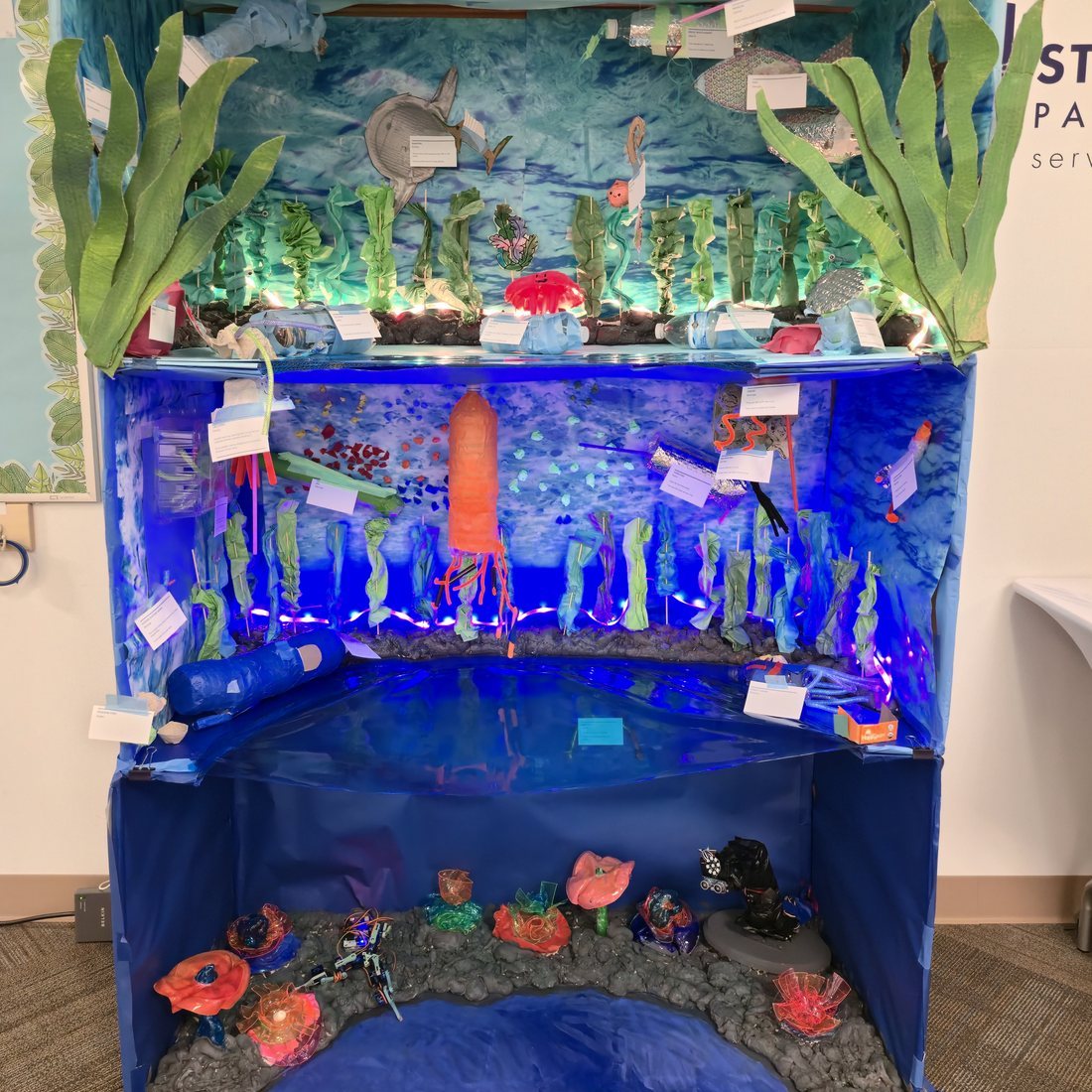
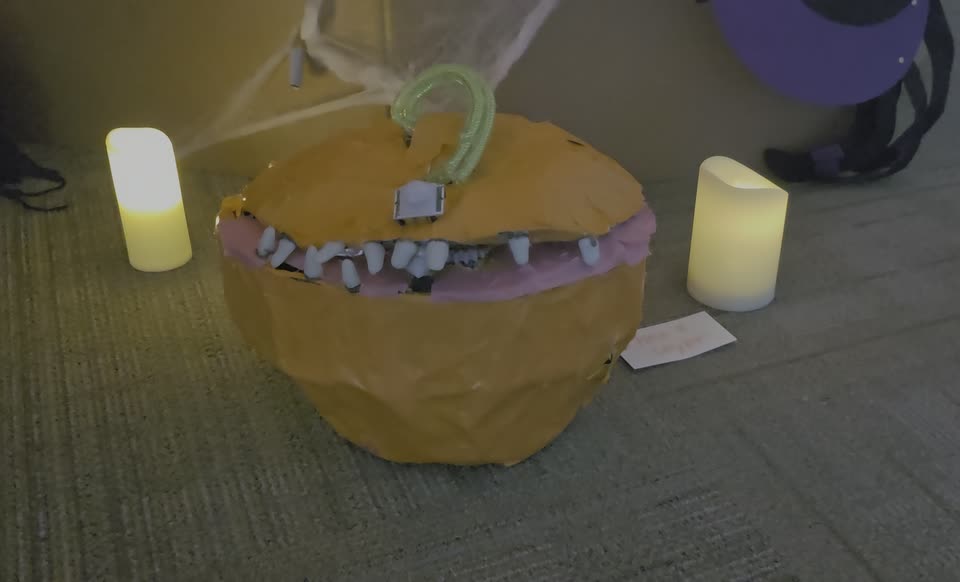
The three-level ocean, built across grades at a K–8 school.A fifth grader's animatronic pumpkin from the transforming house. Both builds are documented on the interactive page.
I received the Laurence McMillin Excellence in Teaching Award in 2015.
The Documents
Access to curriculum documents
I wrote these courses for the schools that employed me, and the curriculum documents belong to those schools. What is on this page is my own account of designing and teaching them.
The documents themselves sit on my art portfolio, behind a password, alongside the rest of my teaching documentation. I give out access on request, and to anyone reviewing an application.