OMEGA
Oceanic Measurement & Environmental Geospatial Array is a custom underwater sensing and mapping system built around field data collection, sensor integration, logging, bathymetric reconstruction, and geospatial visualization.
The work collected here grows out of learning through making and experimentation, and is shared openly so others can learn from it, build on it, or teach with it.
It includes projects, tools, documentation, and educational resources.
The project combines an Arduino-based survey device with a Python processing workflow. In the field, measurements are checked against GPS quality, fix age, platform orientation, speed, spacing, and depth stability. Afterward, the accepted dataset is turned into depth maps, interpolated surfaces, contour maps, and georeferenced outputs.
OMEGA is organized around three stages: capture, validation, and reconstruction. That structure makes it useful both as a practical field system and as a way of explaining how the larger workflow operates.
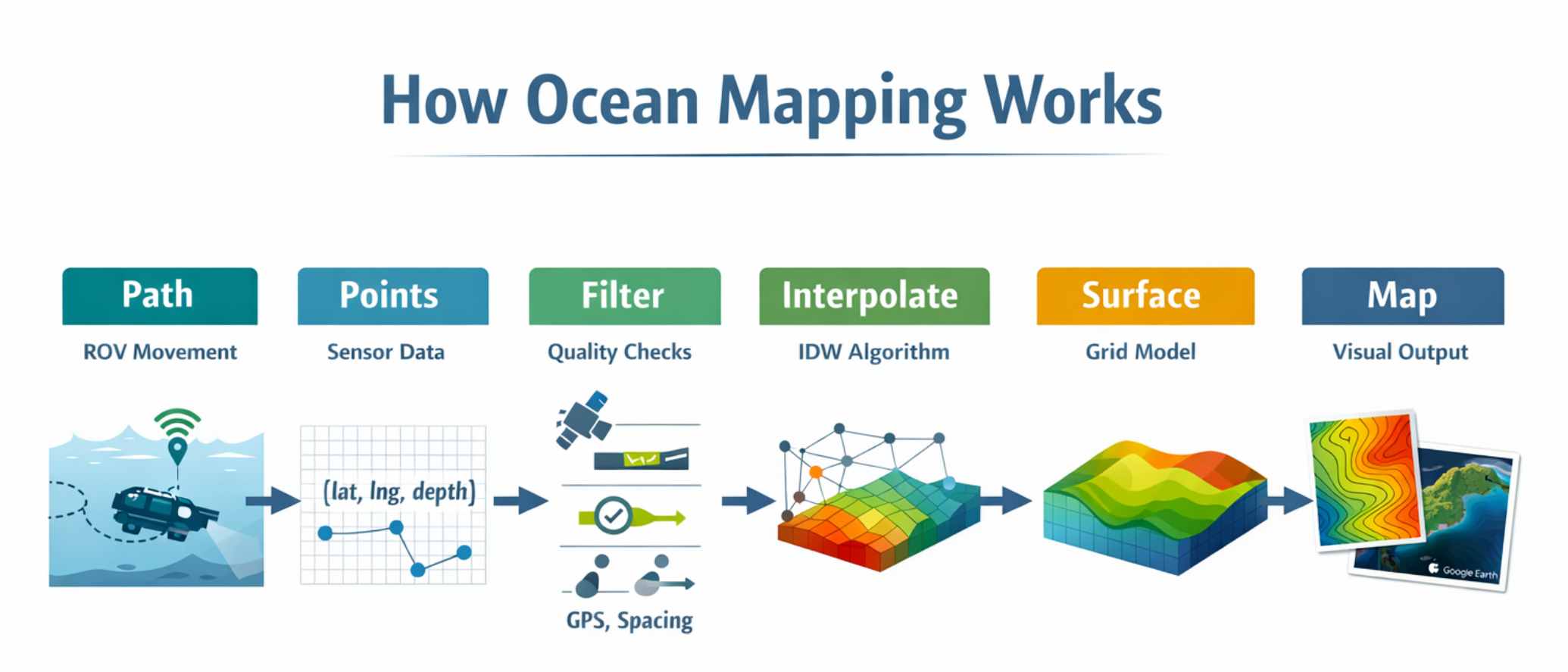
The public repository includes the Arduino logger, Python mapping scripts, documentation, example data, and a visual diagram of the overall pipeline.
Projects in environmental sensing, geospatial mapping, communications, physical computing, and adjacent research-driven work.
Oceanic Measurement & Environmental Geospatial Array is a custom underwater sensing and mapping system built around field data collection, sensor integration, logging, bathymetric reconstruction, and geospatial visualization.
A developing companion project focused on marine communications, field networking, and moving data between distributed devices operating across shoreline and near-water environments.
It is still taking shape, but it will eventually have its own documentation, research notes, and technical pages here as the project becomes more defined.
These pages break the system into its main parts: how depth is measured, how mapping points are accepted or rejected, and how the Python workflow turns those accepted points into bathymetric outputs.
A compact guide to the full workflow: capture, validation, logging, and reconstruction.
Open pageHow sonar estimates depth, why the speed of sound matters, why temperature changes the reading, and where salinity fits into the larger picture.
Open pageHow GPS quality, fix age, motion limits, depth stability, and spacing determine whether a point becomes part of the mapping dataset.
Open pageHow accepted survey points are turned into interpolated surfaces, contour maps, KML files, and Google Earth overlays.
Open pageA dedicated page for live readings, downloadable files, metadata, and quality notes. Currently under construction.
Open pageEntry points for the main OMEGA documentation, research context, and data pages. Teaching material now lives on its own page so the main portfolio can stay focused on technical projects and documentation.
A hub page for the system workflow, core hardware, data pipeline, logging logic, and linked topic pages.
OMEGAAcoustic depth sensing, sound speed, temperature correction, salinity context, and the physics behind the depth estimate.
OMEGAHow OMEGA tests GPS quality, timing, motion, spacing, and depth stability before a point enters the mapping dataset.
OMEGAHow accepted survey points become interpolated bathymetric surfaces, contours, and georeferenced outputs.
OMEGAScientific context and inline-cited material on hydrography, underwater acoustics, water-column physics, interpolation, and bottom change.
OMEGALive access, downloadable files, metadata, and data status information for OMEGA. Under construction.
TeachingA dedicated page for current teaching materials, course documentation, and future curriculum, workshop, and resource content.
Repositories, project pages, selected work, and contact.
This portfolio centers environmental sensing, geospatial workflows, marine communications, physical computing, and project documentation. This section brings together the main entry points into the main repository, public project pages, artwork, and contact information.