OMEGA
Oceanic Measurement & Environmental Geospatial Array is a custom underwater sensing and mapping system built around field data collection, sensor integration, logging, bathymetric mapping, and geospatial visualization.
This site brings together technical projects I’ve built over time, including environmental sensing systems, geospatial workflows, Arduino-based logging tools, Python data processing, and communications systems.
It brings these projects into one place, along with the tools, methods, and documentation that support them.
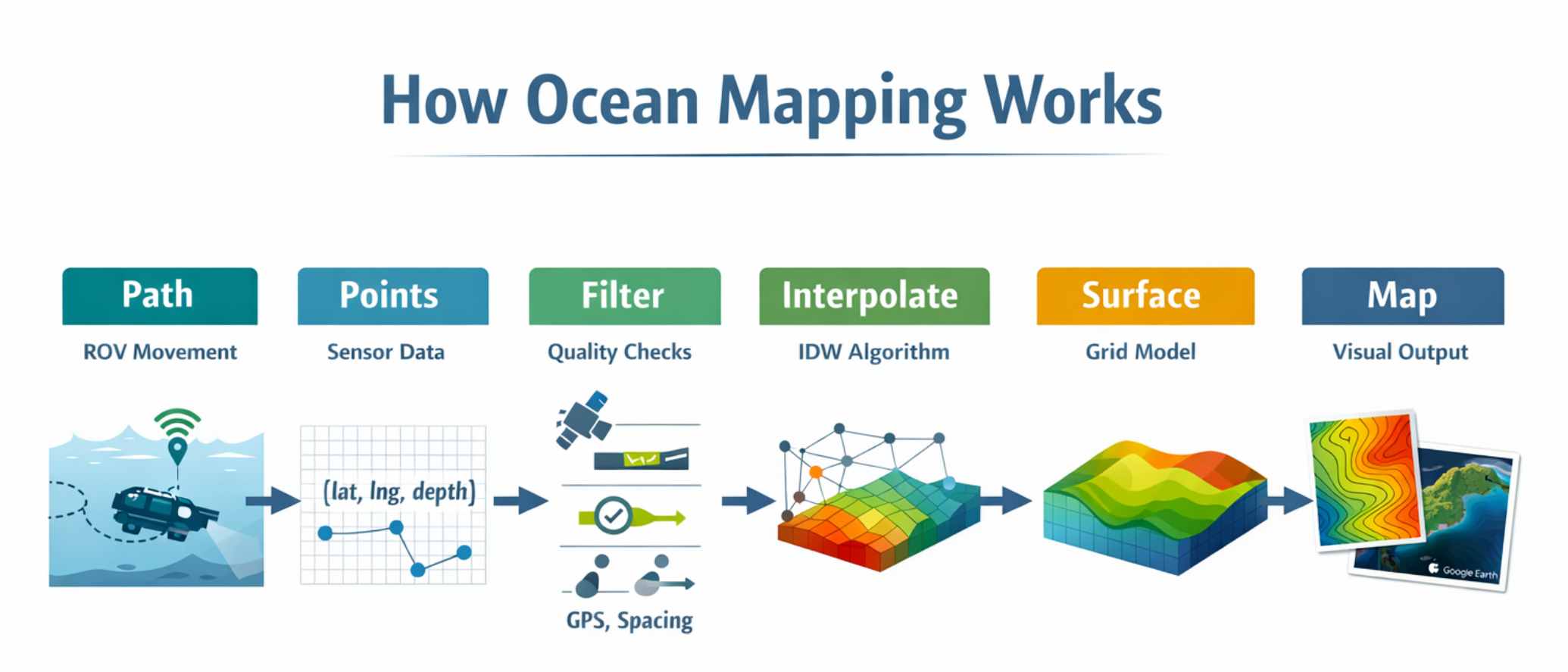
The project combines an Arduino-based capture device with a Python-based processing workflow. During acquisition, measurements are filtered using GPS quality, fix age, platform orientation, speed, and spacing constraints; afterward, the resulting mapping dataset is converted into depth maps, interpolated surfaces, contour maps, and georeferenced outputs.
OMEGA is structured to separate capture, validation, and reconstruction into distinct stages. That architecture makes the project useful both as a field tool and as a clear technical case study.
The public repository includes the Arduino logger, Python mapping scripts, documentation, example data, and a visual pipeline diagram for the full workflow.
Technical and hybrid projects in environmental sensing, communications systems, geospatial workflows, physical computing, and field-based research.
Oceanic Measurement & Environmental Geospatial Array is a custom underwater sensing and mapping system built around field data collection, sensor integration, logging, bathymetric mapping, and geospatial visualization.
The distributed communications and networking branch of OMEGA, focused on resilient marine and littoral communication between shore systems, buoys, vessels, fixed sensor arrays, diver-support tools, underwater sensor nodes, and other field devices.
It is being developed as a modular system designed to bridge surface RF links, Wi-Fi, long-range backhaul, and future underwater acoustic and optical interfaces into one coherent network layer.
These pages focus on the structure of the project itself: how the device measures depth, how mapping points are accepted or rejected, and how the Python scripts turn those accepted points into bathymetric outputs.
A compact guide to the full workflow: capture, validation, logging, and reconstruction.
Open pageHow sonar estimates depth, why the speed of sound matters, why temperature changes the reading, and where salinity fits into the larger picture.
Open pageHow GPS quality, fix age, motion limits, depth stability, and spacing determine whether a point becomes part of the mapping dataset.
Open pageHow accepted survey points are turned into interpolated surfaces, contour maps, KML files, and Google Earth overlays.
Open pageAlongside the project pages, this site includes public technical documentation and teaching materials.
A guided overview of the OMEGA workflow with links into sensing, validation, and mapping.
Open guideDepth measurement, sound speed, temperature correction, and the role of salinity.
Open pageGPS precision, fix age, tilt, speed, smoothing, and spacing in the accepted mapping dataset.
Open pageHow the Python scripts build interpolated surfaces, contours, and geographic overlays.
Open pageStudent-facing guides and classroom materials developed around coding, physical computing, and design.
View documentationSelected teaching documentation connected to coding, design, marine science, and fabrication.
View pagesRepositories, project logs, selected work, and contact.
This portfolio centers environmental sensing, geospatial workflows, marine communications, physical computing, and installation systems. The links here provide direct access to the main repository, the public project log, selected artwork, and contact information.